
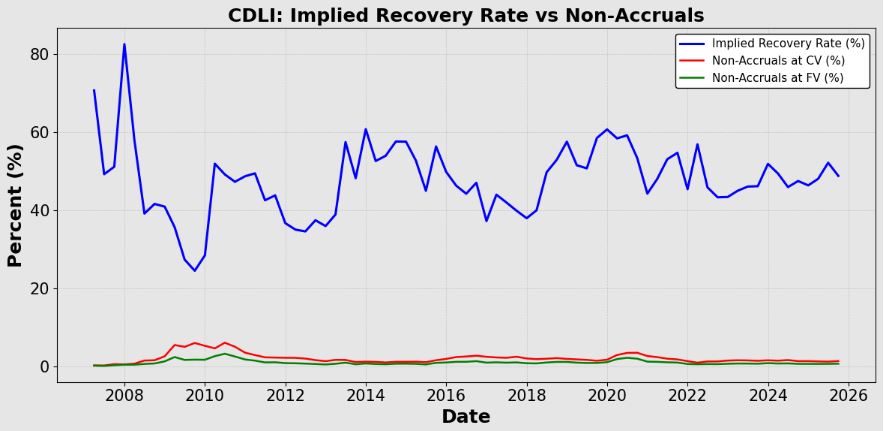
Recent commentary around declining recovery rates in private credit risks overstating what the data actually shows. The figures require context.
To level set, recovery rates apply only to loans that have already entered non-accrual status. That group, according to the Cliffwater Direct Lending Index, represents roughly 1% of total portfolio value across the market. As a result, even a meaningful decline in recoveries affects only a small fraction of assets and cannot, by itself, signal broad deterioration across private credit.
More important is what the rest of the data indicates. Market data shows that net realized losses and net unrealized losses remain very low, both hovering near 1% in recent periods. Historically, material spikes in losses both realized and unrealized have occurred primarily during periods of severe stress, such as the global financial crisis and the COVID pandemic. In each case, realized and expected losses rose temporarily before receding as markets stabilized and recoveries followed. Outside of those episodes, loss levels have remained consistently contained.
It is also important to recognize that recoveries are a function of market conditions. In environments with ample liquidity and affordable capital, assets sold under pressure tend to clear at higher valuations. Recoveries realized during downturns, by contrast, occur amid economic stress and forced selling, often resulting in materially lower outcomes.
The key takeaway is that private credit continues to absorb stress effectively. Borrowers under pressure are often managed through amendments, extensions, or restructurings that preserve enterprise value and avoid forced defaults. While these interventions can delay defaults and sometimes reduce ultimate recoveries, they play a critical role in keeping overall portfolio losses low.
Recovery statistics, viewed in isolation, can therefore be misleading. When considered alongside persistently low realized and unrealized losses, they reinforce rather than undermine the case for private credit as a durable component of long-term portfolios.