
Private Credit Weathers the AI Storm

Artificial intelligence is reshaping enterprise software at a pace that has unsettled borrowers, lenders, and equity investors alike. Yet inside the private credit market, the story is one of resilience, and the alarm signals flashing in public markets may be telling a misleading story. A technical paper published by Adnate Capital finds that AI-driven stress […]
Technical Paper: Credit Resilience Under Artificial Intelligence-Driven Sectoral Disruption: Evidence from Software Exposure and BDC Equity Pricing Dynamics

Abstract This paper examines the resilience of private credit portfolios to disruption in the enterprise software sector attributable to the rapid commercialization of large language models and generative artificial intelligence. Drawing on publicly available filings, earnings disclosures, and regulatory reports from major business development companies (BDCs) and direct lending platforms for the period 2022 to […]
Private Markets Are Big Enough to Be Misunderstood
The real story unfolding in private credit has less to do with any single platform and more to do with how the asset class itself is growing. For most of its modern history, private credit was built around institutional capital, that is pensions, insurers, and endowments comfortable with long lockups and predictable cash flows. Loans […]
Why Falling Recovery Rates Aren’t a Verdict on Private Credit
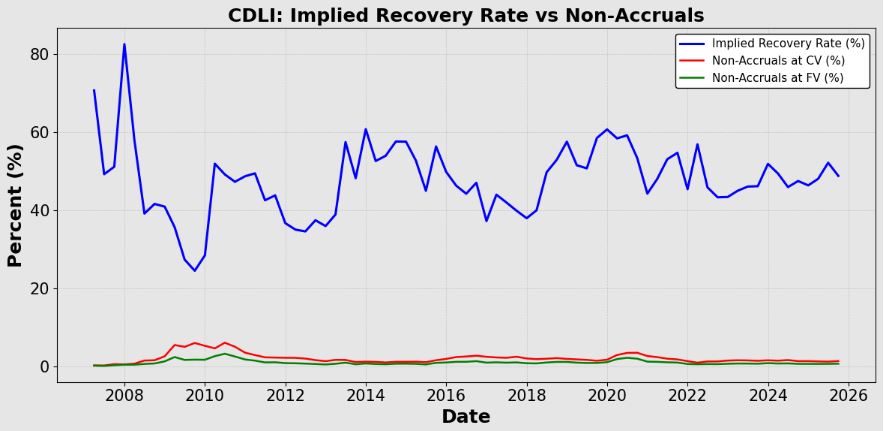
Recent commentary around declining recovery rates in private credit risks overstating what the data actually shows. The figures require context. To level set, recovery rates apply only to loans that have already entered non-accrual status. That group, according to the Cliffwater Direct Lending Index, represents roughly 1% of total portfolio value across the market. As […]
The Private Credit Panic Is Missing the Point

Warnings that private credit defaults could reach 13% in a worst-case scenario make for eye-catching headlines. They should not be mistaken for a verdict on the asset class. What they really express is a growing discomfort with markets that prices risk explicitly while others continue to price optimism. Private credit is not public markets with […]
While Public Markets Price Narratives, Private Credit Prices Control

Markets have always treated debt as a background variable: important, but rarely decisive until conditions force it into the foreground. In bull markets, leverage is rationalized, refinancing is assumed, and rising asset prices are taken as proof that balance sheets are sound. Today’s optimism follows that familiar script, but beneath the surface, debt and its […]
The Risk Investors Keep Missing: Execution

For years, investors have focused on the familiar variable interest rates, inflation, geopolitics, and market volatility. Entire strategies are built around predicting central bank moves or anticipating shifts in sentiment. Yet one of the most important risks in today’s market rarely appears in a model or forecast. That risk is execution. In a world awash […]
When Markets Are Volatile, Structures Shouldn’t Be

Volatility has become the defining feature of modern markets. Interest rates swing sharply. Geopolitical risks flare without warning. Capital moves faster than ever, reacting to headlines, algorithms, and sentiment shifts. For investors, uncertainty is no longer an exception, it is the baseline. Yet amid this turbulence, one truth is becoming increasingly clear: while markets may […]
The Economic Cost of Financial Borders

In a world where goods, data, and ideas move rapidly, capital remains comparatively immobile. Across many emerging economies, particularly in Africa, financial flows are constrained by capital controls, foreign exchange regulations, and policy uncertainty. These constraints function as financial borders. While often justified as tools of macroeconomic stability, they impose real economic costs through weaker […]
Why a Flood of Corporate Bonds Could Push Rates Higher

A quiet shift is taking place in global bond markets. Large, highly rated companies are issuing more debt than they have in years. On the surface, this looks like a sign of confidence. In reality, it is beginning to change how interest rates and credit markets behave. Bond markets, like any market, are governed by […]